In modern steelmaking, microalloying is vital for achieving high tensile strength, superior weldability, and impact toughness without adding excessive carbon. Among strengthening elements, Vanadium (V) has long been the gold standard for precipitation strengthening and grain refinement.
However, when selecting a vanadium additive, steel plant metallurgists and procurement directors face a recurring dilemma: Should you use traditional Ferrovanadium (FeV) or modern Vanadium-Nitrogen Alloy (VN)?
Choosing the wrong alloy directly impacts your production costs, yield consistency, and final mechanical properties. Below is a comprehensive metallurgical and economic comparison to help you choose the best additive for your steelmaking operations.
To understand their performance, we must look at their chemical compositions and how they behave in molten steel.
Ferrovanadium is a master alloy composed primarily of iron and vanadium, typically supplied as FeV50 (50–55% V) or FeV80 (78–82% V).
The Mechanism: Vanadium dissolves in the molten steel and forms vanadium carbides (VCVC) and vanadium nitrides (VNVN) during subsequent rolling and cooling.
The Limitation: FeV relies solely on the residual nitrogen inherently present in molten steel (often just 30–80 ppm). Because nitrogen levels are limited, much of the vanadium precipitates only as coarser carbides rather than finer, more strengthening nitrides.
.jpg)
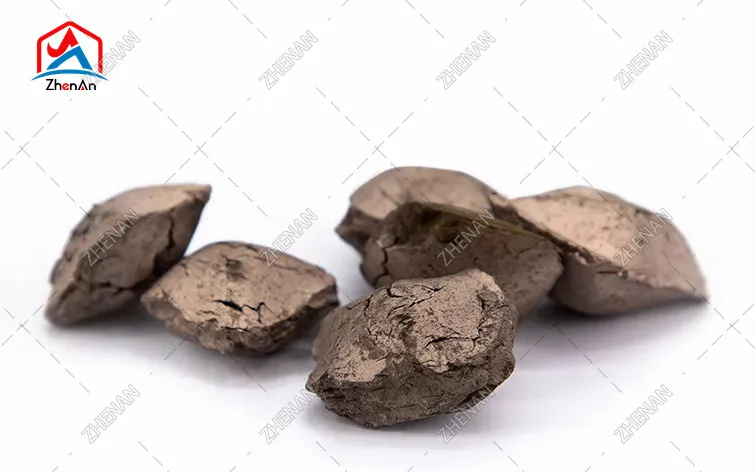
Vanadium-Nitrogen alloy (commonly VN12 or VN16) typically contains 77–80% Vanadium and 12–16% Nitrogen. It is produced by the vacuum carbon reduction and nitridation of vanadium pentoxide (V2O5V2O5).
The Mechanism: VN deliberately introduces nitrogen in a 1:4 or 1:5 stoichiometric ratio with vanadium.
The Advantage: Vanadium and nitrogen have a high chemical affinity. The deliberate addition of nitrogen dramatically promotes the formation of extremely fine, densely dispersed vanadium carbonitride [V(C,N)V(C,N)] particles during austenite-to-ferrite transformation. This intensifies the precipitation strengthening effect while pinning austenite grain boundaries.
| Feature / Metric | Ferrovanadium (FeV80 / FeV50) | Vanadium-Nitrogen Alloy (VN16) | Winner / Advantage |
| Typical Chemical Composition | V: 50-82%, C: 0.1-0.3%, Fe: Bal. | V: 77-81%, N: 12-16%, C: ~6% | VN (delivers active nitrogen) |
| Specific Vanadium Consumption | Standard baseline (100%) | 20% to 40% less V required | VN (Major cost-saver) |
| Vanadium Recovery Rate | 85% – 92% | 95% – 98% | VN (Higher & more stable) |
| Density (Tapping Addition) | ~6.5 - 8.0 g/cm³ | ~4.5 - 5.5 g/cm³ | FeV (Easier immersion in slag) |
| Risk of Strain Aging | Extremely Low | Potential risk in deep-drawing steels | FeV (Safer for ultra-clean steels) |
| Standard Applications | Tool steels, HSLA strip, cast irons | Rebar (HRB400/500/600), section steel | Application-dependent |
If your plant produces high-strength deformed rebar (e.g., ASTM A615/A706 Grade 60/80, BS4449, or China HRB400/HRB500), Vanadium-Nitrogen alloy is unequivocally the superior choice.
The 30% Vanadium Savings: Because the supplied nitrogen maximizes precipitation strengthening, adding 0.03% V via VN alloy achieves the same yield strength as adding 0.045%–0.050% V via FeV.
Given the high and volatile market price of vanadium pentoxide, this 30–40% reduction in raw vanadium usage delivers massive production cost savings per ton of steel.
Excess interstitial free nitrogen can cause "strain aging" (embrittlement over time) and reduce formability in cold-rolled sheets and deep-drawing automotive grades.
In such applications, strict upper limits are placed on nitrogen content (N<40 ppmN<40 ppm)
Ferrovanadium is the mandatory choice here because it microalloys without elevating the final steel's nitrogen pool.
FeV has a higher specific gravity, allowing it to penetrate through thick ladle slag layers easily into the molten pool.
VN alloy, being lighter, requires standardized ladle addition practices: it should be added to the tapping stream during the early-to-mid tapping stage (after preliminary deoxidation) to prevent it from floating on top of slag and oxidizing. However, when added correctly, VN achieves a remarkably stable vanadium recovery rate above 95%.
.jpg)
Consider a steel mill producing 1,000,000 tons of Grade 500 rebar annually:
Using FeV: Target Vanadium addition = 0.045%. Total pure V required = 450 tons.
Using VN Alloy: Target Vanadium addition reduced to 0.032% due to nitrogen synergy. Total pure V required = 320 tons.
Net Vanadium Savings: 130 tons of pure vanadium annually.
At an average vanadium price of $35,000/ton, switching from FeV to VN can deliver over $4,500,000 in raw material cost reductions per year, even after accounting for the price differential of VN briquettes.
Select Vanadium-Nitrogen (VN) Alloy if:
Your primary products are high-strength construction rebar, structural sections, or high-strength plate.
Your goal is reducing ferroalloy procurement costs.
Your ladle refining/tapping process allows controlled addition.
Select Ferrovanadium (FeV) if:
You produce automotive sheet, deep-drawing grades, wire rod for cold heading, or tool/die steels.
Your metallurgy demands extremely low nitrogen concentrations.
You operate special alloy casting processes sensitive to interstitial nitrides.
Are erratic alloy recovery rates driving up your steelmaking costs? We supply certified FeV50, FeV80, and VN12 / VN16 briquettes to global steel plants and foundries.
✅ Consistent Nitrogen & Vanadium ratios for predictable yield strength
✅ Moisture-proof, vacuum/nitrogen-flushed packaging (10kg bags / 1-ton bulk bags)
✅ Full SGS/BV chemical composition inspection certificates with every batch